Cultural Empathy · 1 min read
Building proprietary, sovereign, consent-tracked datasets for low-resource languages
The next moat is data you own, can prove consent for, and can keep resident. How we build proprietary, sovereign, consent-tracked datasets for low-resource languages — and where it heads next.
By Cognegica Linguistics Team
Linguistics & low-resource language research
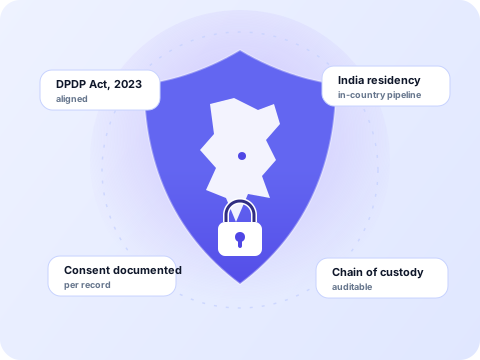
For low-resource languages, the most valuable data is the data you own outright — built native-speaker-first, with consent you can prove and residency you can guarantee. That combination is hard to replicate, which is exactly what makes it a durable advantage.
Proprietary by construction
Because the data is collected to spec rather than scraped, it's proprietary from the first record — and rights-cleared enough to train on commercially.
Sovereign by design
Sovereignty means three concrete things: data residency, informed consent, and provenance tracked per record. For regulated and low-resource-language data, that's not optional — it's what makes the dataset usable at all. See Sovereign data.
Consent and provenance on every record
Informed consent is captured in the contributor's language and provenance is tracked end to end, so the chain of custody is auditable.
Where this heads next
The same discipline — recruitment, environment, multi-layer QA, consent and provenance — is what we're extending into multimodal and embodied data for Physical AI. It's a forward-looking capability built on documented foundations, not a pivot away from them.
About the author
Cognegica Linguistics Team
Linguistics & low-resource language research
The Cognegica Linguistics Team works across the language registry on low-resource and Indic languages, dialect and accent capture, and cultural and cross-lingual evaluation. This is an editable team identity — a named linguist with a public profile can be assigned to it later in the admin.
Related insights
-
Aug 23, 2026 · 1 min
Building a 400-language collection network
Reaching the world's low-resource languages isn't a scraping problem — it's a people problem. How we built a native-speaker collection network across 400 languages.