LLM-Native Craft · 1 min read
Edge-case and non-speech-event annotation
[noise], [laughter], [overlapping speech] — the events that aren't words are often what break a model. How we annotate non-speech events and transcription edge cases consistently.
By Cognegica Quality & Standards
QA & annotation-standards team
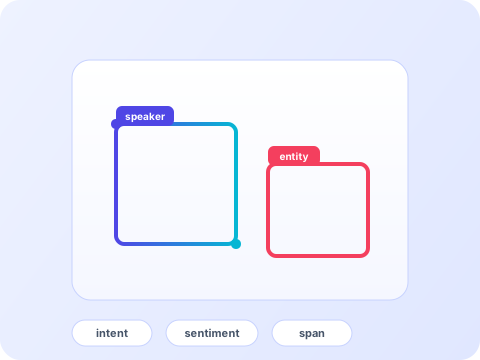
The hardest part of transcription often isn't the words — it's everything around them. Laughter, music, background noise and overlapping speech all carry signal, and if they're transcribed inconsistently they quietly poison training and evaluation.
A fixed vocabulary of event tags
We annotate non-speech events with an explicit, fixed vocabulary — [noise], [laughter], [music] and [overlapping speech] — so the same event is always marked the same way. Consistency beats cleverness here.
Overlapping speech is its own discipline
Multi-speaker overlap is where generic transcription falls apart. We pair non-speech event tagging with speaker diarization so overlap is both marked and attributed to the right speakers.
Dialect and accent edge cases
Native-linguist transcribers handle dialect and accent edge cases that trip up generic typists, keeping orthography accurate to each script's conventions.
Format for consistency
Everything is delivered UTF-8 with standardized punctuation, consistent spacing and project annotation tags — so the edge cases stay machine-readable, not just human-readable.
About the author
Cognegica Quality & Standards
QA & annotation-standards team
Cognegica Quality & Standards is the internal team that defines and enforces our annotation guidelines, multi-layer QA, native-linguist review and inter-annotator agreement reporting. This is an editable team identity — a named reviewer with a public profile can be assigned to it later in the admin.
Related insights
-
Aug 23, 2026 · 1 min
Physical AI data as a service: what buyers actually need
Robotics and embodied AI need data too — but it's collection and annotation, not a research moonshot. Here's what buyers actually need from a Physical AI data partner.
-
Aug 23, 2026 · 1 min
Controlling environmental and background noise in audio and video capture
Background noise can make or break a speech dataset. The recording-environment standards and controlled noise variations we use to keep audio and video capture clean — and realistic.
-
Aug 23, 2026 · 1 min
Speaker diarization and labeling across multi-speaker recordings
Who said what, when — diarization is deceptively hard in real, multi-speaker, multilingual audio. How we identify, segment and label speakers consistently across recordings.