LLM-Native Craft · 1 min read
Physical AI data as a service: what buyers actually need
Robotics and embodied AI need data too — but it's collection and annotation, not a research moonshot. Here's what buyers actually need from a Physical AI data partner.
By Cognegica Data Operations
Field collection & delivery team
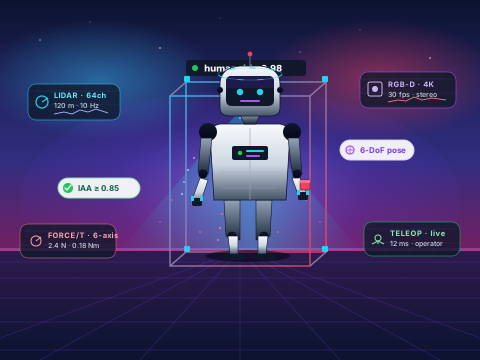
Physical AI — robotics, embodied agents, autonomous systems — has a data problem that looks new but isn't. Strip away the hype and it's the same two disciplines we've always done: collection and annotation, applied to sensor, teleoperation and environment data.
It's a service, not a science project
Buyers don't need a research partnership to get embodied-AI data. They need a vendor who can capture multimodal data to spec, label it at a measured quality bar, and deliver it rights-cleared. That's a data service — the same way text and speech are.
What buyers actually ask for
- Multimodal capture: video, depth, IMU, force/tactile, teleop traces.
- Consistent annotation schemas with documented inter-annotator agreement.
- Consent and provenance for any human-subject data.
- An India-residency option where the program is regulated.
How we approach it
We deliver Physical AI data exactly like the rest of our services: scoped, measured, rights-cleared, and documented. No moonshot framing — just data you can train on.
About the author
Cognegica Data Operations
Field collection & delivery team
Cognegica Data Operations is the internal team responsible for field-grade data collection, contributor recruitment, consent and delivery across our multilingual programs. This is an editable team identity — a named individual with a public profile can be assigned to it later in the admin.
Related insights
-
Aug 23, 2026 · 1 min
Controlling environmental and background noise in audio and video capture
Background noise can make or break a speech dataset. The recording-environment standards and controlled noise variations we use to keep audio and video capture clean — and realistic.
-
Aug 23, 2026 · 1 min
Edge-case and non-speech-event annotation
[noise], [laughter], [overlapping speech] — the events that aren't words are often what break a model. How we annotate non-speech events and transcription edge cases consistently.
-
Aug 23, 2026 · 1 min
Speaker diarization and labeling across multi-speaker recordings
Who said what, when — diarization is deceptively hard in real, multi-speaker, multilingual audio. How we identify, segment and label speakers consistently across recordings.