Trust & Compliance · 1 min read
Multi-layer QA: catching script-adherence and metadata errors
Most data programs fail quietly in QA. How our multi-layer QA process — native-linguist review plus script-adherence and metadata verification — catches the errors that matter.
By Cognegica Quality & Standards
QA & annotation-standards team
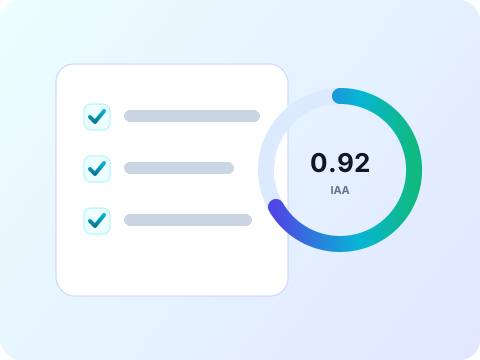
Quality is where most data programs fail — quietly, and only visible once a model regresses. A single review pass isn't enough. We run a multi-layer QA process that catches different classes of error at different stages.
Native linguists in the loop
Native-linguist involvement is the backbone of our QA. They catch orthographic, dialectal and pragmatic errors that automated checks and non-native reviewers miss entirely.
Script adherence and guideline compliance
Each record is checked against the project guidelines — orthography, diarization, event tags and formatting — so the delivery is consistent, not just individually plausible.
Metadata verification
Metadata errors are easy to miss and expensive later. We verify language and dialect, speaker demographics, device type, environment category and location, so the dataset can be balanced and audited.
Errors feed back into guidelines
Errors are categorised and routed back into the guidelines and SOP workflows, so recurring issues get designed out. That's the difference between QA as a gate and QA as a system.
About the author
Cognegica Quality & Standards
QA & annotation-standards team
Cognegica Quality & Standards is the internal team that defines and enforces our annotation guidelines, multi-layer QA, native-linguist review and inter-annotator agreement reporting. This is an editable team identity — a named reviewer with a public profile can be assigned to it later in the admin.
Related insights
-
Aug 23, 2026 · 1 min
Rights-cleared data: why it matters more every quarter
Provenance and consent are moving from nice-to-have to procurement blockers. What rights-cleared training data actually means — and why buyers now demand it.
-
Aug 23, 2026 · 1 min
Sovereign AI data and India residency: what it really requires
India-residency is more than where a file sits. Here's what sovereign AI data delivery actually requires — and why regulated buyers are asking for it.
-
Aug 23, 2026 · 1 min
RLHF, adversarial prompts and toxicity annotation for safe GenAI
Safe generative AI needs more than a filter. How we combine human-in-the-loop RLHF, adversarial prompt engineering and native-speaker toxicity annotation into one safety workflow.