Trust & Compliance · 1 min read
Rights-cleared data: why it matters more every quarter
Provenance and consent are moving from nice-to-have to procurement blockers. What rights-cleared training data actually means — and why buyers now demand it.
By Cognegica Data Operations
Field collection & delivery team
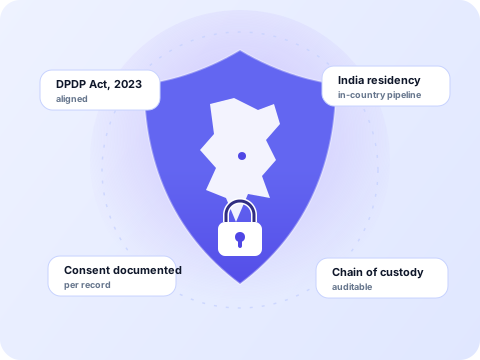
For years, AI training data was sourced first and questioned later. That era is ending. Regulators, enterprise procurement teams and the courts are all converging on the same question: where did this data come from, and did the people in it agree to be there?
What 'rights-cleared' actually means
It means three things, documented: the contributors consented explicitly, they were compensated fairly, and the licensing terms let you use the data for what you actually intend. Anything less is a liability you're carrying into your model.
Why it's now a buying criterion
Enterprise and government buyers increasingly require provenance documentation before they'll license a dataset. A corpus you can't defend on rights is a corpus they can't buy. That's why every dataset we sell ships with a data card covering consent, provenance and license terms.
How we build it in
Our collection and annotation programs record consent and provenance from the first contributor. See Sovereign data for how we handle residency on top of that.
About the author
Cognegica Data Operations
Field collection & delivery team
Cognegica Data Operations is the internal team responsible for field-grade data collection, contributor recruitment, consent and delivery across our multilingual programs. This is an editable team identity — a named individual with a public profile can be assigned to it later in the admin.
Related insights
-
Aug 23, 2026 · 1 min
Sovereign AI data and India residency: what it really requires
India-residency is more than where a file sits. Here's what sovereign AI data delivery actually requires — and why regulated buyers are asking for it.
-
Aug 23, 2026 · 1 min
Multi-layer QA: catching script-adherence and metadata errors
Most data programs fail quietly in QA. How our multi-layer QA process — native-linguist review plus script-adherence and metadata verification — catches the errors that matter.
-
Aug 23, 2026 · 1 min
RLHF, adversarial prompts and toxicity annotation for safe GenAI
Safe generative AI needs more than a filter. How we combine human-in-the-loop RLHF, adversarial prompt engineering and native-speaker toxicity annotation into one safety workflow.